Monday, August 17, 2015

Remembering One Of Sports' Greatest Humanitarians

When coming up with ideas to post on this blog, I usually try to look at a sports event, either past or present, and share what I hope is a somewhat unique perspective; one that is both thought-provoking and interesting enough to generate some dialogue. I don't know that this post falls into that category because it is being written more as a tribute than anything else. I have a personal connection to this as well because it reminds me of the only time in my life when I was in the presence of  a sports legend and someone that was so driven to help people in need that it eventually cost him his life.

When I was nine years old, my favorite baseball team, the Baltimore Orioles, made it to the World Series for the third consecutive year. They were the defending champions, had won over 100 games and they had four 20 game winners in their starting rotation. Their opponents in the World Series that year were the Pittsburgh Pirates. Even though the Orioles were favored, I knew that the Pirates were no joke. In fact, they had the second highest team batting average in baseball that year. It was a classic match up of good hitting vs. good pitching. To make a long story short (as well as to avoid opening some old wounds), the Pirates won that series in seven games, and they owed  that championship to one player. Along with Hank Aaron and Willie Mays, he was probably the best outfielder of his era. His name was Roberto Clemente.

During his 18 year MLB career, Clemente had a career batting average of .317. He hit over .300 in 13 of those 18 seasons including eight consecutive years from 1960 to 1967. Clemente was also a superb right fielder, having won 12 Gold Gloves in a row from 1961-1972. He had one of the strongest, most accurate arms in baseball. Those base runners trying to test it usually found it to be an exercise in futility. Among right fielders, Clemente had 260 assists, which far outdistanced the 186 by Hank Aaron who was in second place. His best year statistically was 1966 when he was voted the National League's MVP. In 1971, NBC broadcast the first World Series game at night during prime time. That's when the entire country found out what the city of Pittsburgh already knew; that Roberto Clemente was one hell of a baseball player. He hit safely in every game. The Orioles simply had no answer for him. Clemente batted .414 including two home runs. The second one came in the series clinching seventh game. He also made several outstanding defensive plays in right field throughout the series that stopped Orioles rallies dead in their tracks (much to my frustration). For all of these efforts, Clemente was named the series MVP. He was the first Hispanic player to earn that honor.

This year marks the 60th anniversary of Roberto Clemente's first season in the major leagues. Tim Kirkjian from ESPN put together a nice segment on him a few months ago marking the occasion. Clemente would be celebrating his 81st birthday on  August 18th were it not for his untimely passing. So now you understand the motivation for this post.

I actually had a chance to meet Clemente when the Pirates came to Miami to play the Orioles during spring training in March, 1972. My Little League team was also called the Pirates. My coach was from Puerto Rico, and he had played semi-pro baseball there prior to joining the army. He took his son and me to that game and we got there early enough to try and get some autographs. The next thing I know my coach was able to get Clemente's attention by saying something to him in Spanish. Five minutes later, my buddy Juan and I are standing next to this baseball legend getting our picture taken. Somewhere in my house I have the color photograph. This is the black and white one that appeared in our base newspaper. I remember I was way too shy to mutter anything more than a "thank you" after my coach snapped off a couple shots. I also recall that Clemente's hands were gigantic for a man of his size (5'11", 175 lbs). But besides that, even at nine years old I had the feeling that I was standing next to someone who was more than just a great baseball player. Over the next year, I came to find out how right I was about that.

The 1972 baseball season turned out to be Roberto Clemente's last. In what was his final game, he  became only the 11th player at the time to reach 3,000 career hits when he doubled into left field off Jon Matlack of the New York Mets. Fittingly, he acknowledged the crowd's ovation with just a humble tip of his cap. That's the kind of player he was.

Three months later, Roberto Clemente lost his life in a tragic plane crash. On December 23rd, 1972, an earthquake measuring 6.2 in magnitude struck Nicaragua. More than 6,000 people died and over 250,000 were left without shelter. From his home in Puerto Rico, Clemente immediately became involved helping with the relief efforts. He organized three flights to Nicaragua to get food and supplies to the victims. However, he later learned that they had been diverted by corrupt officials in the Nicaraguan government. When he set up the fourth flight, Clemente decided to accompany it himself to ensure the supplies got to the people who needed them. Unfortunately, the DC-7 cargo plane was overloaded by over two tons with relief supplies. The maintenance record on the plane was also a little sketchy. It stalled on take off and crashed off the coast of Puerto Rico on Dec. 31st, 1972. Clemente's body was never recovered.

When I heard the news, I just couldn't believe it.  That was the first time in my life where I recall that someone whom I had met had died less than a year later. It really had an effect on me. After that, I began reading everything I could get my hands on related to Roberto Clemente, and that's when I came to understand that what he accomplished on the baseball diamond was just a small part of his life's story.

Clemente was proud of his Puerto Rican heritage, but he also saw himself representing all of Latin America. Outside of baseball, he was committed to reaching out to help those in need, especially children.  Now you may be wondering how this makes him different from any other athlete that supports a particular cause. I think the biggest reason is because Clemente spent virtually all of his time in the off season helping the less fortunate in his home country and throughout Latin America. He didn't just make appearances here and there. Clemente was completely devoted to helping others through his charity work and he was tireless in this pursuit. He was once quoted as saying, "Anytime you have an opportunity to make a difference in this world and you don't, then you are wasting your time on this earth." To me this indicated that Clemente viewed his role as a true calling. He never forgot his roots, and as his fame as a baseball player grew, he maintained a tremendous sense of empathy for those less fortunate. It is a quality present in all true humanitarians. But sadly, there are rare occasions such as this one where tragedy strikes, resulting in one of them being taken from our world way before his time.

It has been nearly 43 years since Roberto Clemente's death, but his memory continues to live on in Major League baseball. His number 21 was retired by the Pittsburgh Pirates in 1973. That same year, the Baseball Writers Association of America waived the customary five year waiting period for induction into the Hall of Fame and voted Clemente in on the first ballot. He was the first Hispanic player to have a plaque at Cooperstown. Even today, his presence is felt at Heinz Field, the Pirates' home stadium.  The right field wall is exactly 21 feet high to match his number, and is appropriately called the Clemente Wall. But even more impressive is how he continues to be revered for his humanitarian work. The award given to the major league player each year who has demonstrated a commitment to humanitarian causes is now called the Roberto Clemente award. And in 2003, he  was posthumously awarded the our nation's highest civilian honor, Presidential Medal of Freedom. It's just recognition for a man widely acknowledged as one of the greatest humanitarians in all of sports, but had he been alive to accept the award, my guess is that Roberto Clemente would have just humbly nodded in appreciation and then gone right back to helping those in need.

Until next time . . .

Karl

Thursday, July 30, 2015

Why The Class Of 2015 MLB Hall of Fame Pitchers Represent The End Of An Era


Several weeks ago I was watching a show where some scientists were studying layers of sedimentary rock and trying to reconstruct what things were like millions of years ago in that particular part of the world. It was pretty interesting. They were able to determine quite a bit of information by studying the types of rock in the layers, the thickness, and any fossils the layers may have contained. With that information it was possible to figure out when a certain time period ended and another began. Then over the weekend, I watched a recap of the Major League Baseball Hall of Fame induction ceremonies. When I saw the three pitchers who were honored that day, I thought back to that show that I watched on television, and I came to the realization that we may have just seen the end of an era when it comes to major league pitching.

 I began playing baseball when I was seven and continued until I finished high school. And even though I couldn't hit off speed pitches consistently enough to make it to the next level, I have always remained close to the game as a fan. So I always pay particular attention when a new class is voted into the Major League Baseball Hall of Fame. This year, Pedro Martinez, John Smoltz, and Randy Johnson were selected along with Craig Biggio. Martinez, Smoltz and Johnson were arguably the three most dominant pitchers of the past 25 years. In this week's post, I wanted take a brief look at their careers and discuss the changes that we will probably see when it comes to evaluating future pitchers for the Hall of Fame. All the numbers come from the baseball reference.com website.
Image result for pedro martinez
Pedro Martinez
At 5'11" and 170 lbs, Pedro Martinez was the smallest of the trio, but that never stopped him. It always amazed me that he could throw in the mid-90 mph range with that frame. From 1997 to 2003, Martinez was virtually unhittable. During that time, his ERA was never higher than 3.00 and only once was it more than 2.50. He won two Cy Young Awards and was a big reason why the Boston Red Sox were finally able to reverse the curse of Babe Ruth in 2004 and bring home their first World Series Championship in 86 years,


Image result for john smoltz
John Smoltz
John Smoltz had the more traditional power pitcher's build at 6'3", 210 lbs. Not only did he throw hard, he had excellent location. Smoltz was positively clutch in the post season, sporting an impressive 15-4 record and an ERA of 2.67. He was also remarkably resilient. Smoltz missed the entire 2000 season while recovering from Tommy John surgery. Without skipping a beat, he transitioned to the role of closer in the Atlanta Braves bullpen the following year. From 2001-2004, he racked up 154 saves for the perennial division champs, making him the only pitcher inducted into the Hall of Fame with over 200 wins and 150 saves.

Image result for randy johnson
Randy Johnson
Randy Johnson was just a freak of nature, plain and simple. He stood at 6'10", 210 lbs; nearly a foot taller than Martinez. Standing on the mound, he looked closer to eight feet tall. I can't imagine a more intimidating sight for hitters when they stepped into the batter's box than seeing The Big Unit glaring down at them over the top of his glove as he awaited the sign from his catcher. To make matters worse, Johnson's long frame made it seem like by the time he released his fastball, it only had to travel about 45 feet to get to home plate. That's just not fair. Some of you may also remember a wild pitch he uncorked that absolutely vaporized a bird that had the misfortune of trying to occupy the same point in space between home plate and the backstop. The poor thing never stood a chance against a 99 mph fastball. Take a look. Over his 22 year career, Johnson struck out 4,875 batters, which is second only to Nolan Ryan. And in 2004 at age 39, he became the oldest pitcher in Major League Baseball to throw a perfect game.

Martinez, Smoltz, and Johnson represent the last generation of pitchers making the trip to Cooperstown whose greatness can be evaluated using traditional statistics.  Others who pitched during the same period may also earn induction later, but the point is that these three began their careers when baseball was starting to become more specialized, particularly when it came to pitching.  When they took the mound, the goal was to throw a complete game or at the very least get to the eighth inning. If they ran out of gas, a reliever from the bullpen would come and get the last handful of outs to save the game. That is rarely the case now. And because baseball has become more specialized, it's going to change how pitchers will be evaluated for induction into Hall of Fame from this point forward. It will no longer be possible to rely as heavily on the traditional statistics to see how they stack up against previous Hall of Fame pitchers.  The numbers simply won't be there. Let me show you what I mean. I will compare some key statistics from our most recent Hall of Fame inductees to two previous members and also to two of today's pitchers who are having outstanding careers so far and could be on the road to Cooperstown if they they continue to perform at their current high levels.

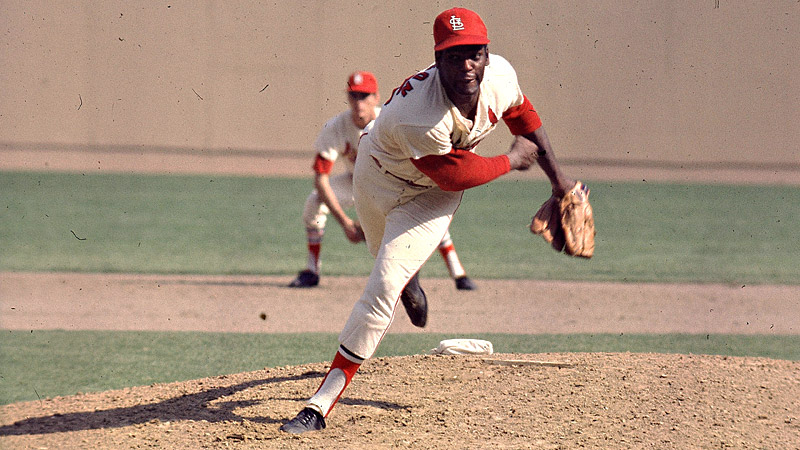
Bob Gibson
Image result for Jim Palmer
Jim Palmer
The two previous Hall of Fame pitchers we will take a look at are Bob Gibson and Jim Palmer. Gibson spent his entire career with the St. Louis Cardinals. He was the ace of their staff throughout the '60s and '70s and led them to two World Series Championships in three appearances. Gibson holds the modern day record for the lowest ERA among starting pitchers in a single season with a microscopic 1.12 in  1968. Jim Palmer played for the Baltimore Orioles for nineteen years. He was a six time 20 game winner and picked up three Cy Young Awards along the way. Palmer holds the distinction of winning a World Series game in three different decades (60's, '70s and '80s).  In his first World Series start in 1966, he shut out the Los Angeles Dodgers 6-0, beating Sandy Koufax in what turned out to be the great left-hander's last major league appearance. Koufax would retire later that year due to an arthritic left elbow. The Orioles swept the Dodgers in that series, and Palmer helped them win two more Fall Classics in 1970 and again in 1983.
Image result for clayton kershaw
Clayton Kershaw

Image result for zack greinke
Zack Greinke

The two current pitchers we will look at are Zack Greinke and Clayton Kershaw. Both have been pitching for at least eight years, and they have clearly established strong reputations as two of the premier pitchers in the major leagues today. The metrics we will compare in the following table will be  the number of years played, won-loss record, innings pitched, complete games and shutouts thrown. The players are listed in chronological order by career to make it easier to pick up on the trends.  Let's see what we've got:

Name
Year Played
W-L
Innings Pitched
Complete Games
Shutouts
Bob Gibson
17
251-174
3,884.1
255
56
Jim Palmer
19
268-152
3,948.0
211
53
Randy Johnson
22
303-166
4135.1
100
37
John Smoltz
21
213-155
3,473.0
53
16
Pedro Martinez
18
219-100
2827.1
46
17
Zack Greinke
12
132-92
2,010.1
14
4
Clayton Kershaw
8
106-55
1519.1
15
11

First of all, take a good look at Randy Johnson's 303 wins. It's not likely that we are going to see another career 300 win pitcher any time soon. The closest right now is Tim Hudson with 220 and he's 39 years old. Clayton Kershaw may have a shot, but he would have to average over 16 wins each year for the next 12 years to make it. That's assuming he has a 20 year pitching career. The only problem is he is only averaging a little over 13 wins each year right now, meaning he would need to perform at an even higher level in order to reach 300 wins. I'm not saying he can't do it, but the odds are not in his favor. 

Now let's break down the number of innings pitched. Johnson has more innings than Jim Palmer and Bob Gibson, But he only averaged 187 innings pitched per year compared to over 200 for Palmer and Gibson. The average numbers for Martinez and Smoltz are in the 160 inning range. The same goes for Greinke. Kershaw is currently averaging about 190 innings per year. It will be interesting to see if this number holds up as his career progresses. The biggest reason for the drop in these averages is the more specialized nature of pitching. The development of the closer and set up man has effectively shortened the game for the starters. It used to be that the relief pitchers were those who didn't quite have what it took to break into or stay in the starting rotation. This was more true with the middle relievers than it was with those that closed out the game. Then there was a concerted effort to develop the "set-up man"; a pitcher who could take the ball in the 7th inning and get his team to the 9th before handing the ball to the closer. So instead of being asked to go the distance, today's starting pitchers only need to make it to the 7th inning before turning the game over to the bullpen. This definitely impacts the number of innings pitched over a career, and potentially affects the pitcher's won-loss record, depending on how good the relievers are at closing out the game. An argument can be made that this will help extend a pitcher's career. It's a fair point, but until more data is available, I don't know that we can make that assertion right now. We'd have to wait until this generation of pitcher's retires before drawing any meaningful conclusions. 

 From there, what we have is a cascading effect. Less innings pitched leads to less complete games. The numbers bear this out. Johnson had 100 complete games, which was less than half of the total for Gibson and Palmer who both had over 200. Then there is a significant drop to Smoltz and Martinez who sit at 53 and 46 respectively. Now take a look at Greinke and Kershaw. They are currently have 14 and 15 complete games respectively. That's less than two per season compared to the double digit complete games Gibson and Palmer averaged each year for their careers. As a result, the number of shutouts are also shrinking. Eight years into his career, Clayton Kershaw has a total of 11 shutouts. Gibson had 23 durng his first eight years. Then he threw a mind-blowing 13 shutouts in 1968. Palmer was right there with him. He had tossed 24 shutouts in his first eight years and then rang up 10 alone in 1975. Moving forward, pitchers will be throwing far fewer shutouts because  many of them are limited by pitch counts. The only time managers are inclined to leave them in longer is if they have a no-hitter or perfect game going. Even if they lose the no-hitter, they are given the chance to finish the game if they still have good stuff. That explains Kershaw's 11 shutouts in only 15 complete games.

Based on today's trends, pitchers will not be able to post the same kinds of numbers as the ones who came before them. In fact, we start to see that drop off when Martinez, Smoltz, and Johnson were pitching from the early 1990s until they retired in 2009. The game just isn't the same. That's why I referred to them earlier as the last of their kind in the modern era. Up until now, statistics like won- loss record, innings pitched, ERA, complete games and shutouts, were what the baseball world used to determine a pitcher's greatness. But now the only one that has any significant weight is the ERA. Total strikeouts are impacted by the starters coming out the game earlier. The pitcher's record is something he has less control over for the same reason. The outcome is totally in the hands of the relievers. And let's face it, there are plenty of them out there who have trouble hanging onto a lead.

Starting now, the baseball writers will have to look more closely at the current analytics to figure out where today's pitchers stand. Using the old methods described above, Greinke and Kershaw would not likely achieve Hall of Fame numbers even when you project them out over an 18-20 year career. Never mind the 300 wins; 250 might be a stretch for either one of them. And forget about innings pitched, complete games and shutouts. They wouldn't come anywhere near those numbers posted by Gibson, Palmer and Johnson. So instead of  the traditional statistics, the focus will be more on today's analytics like wins above replacement (WAR), walks plus hits per innings pitched (WHIP), and defense independent pitching statistics (DIPS). Believe me, those three numbers are just the tip of the iceberg. When I began looking into all the different metrics that are used to evaluate pitchers, there were so many acronyms, it would have made any government agency proud. And whatever you do, please don't ask me how to figure some of them out.  The DIPS calculation alone requires 14 separate steps, and you need seven different pieces of information before you can even get started. Who would have thought that things would have gotten so complex?

As a fan, I need to get a lot smarter on these new analytics so I can carry on an intelligent conversation whenever it turns to potential Hall of Fame pitchers. That's what I think makes the induction of Martinez, Smoltz, and Johnson so significant. It marks the end of one period and the beginning of another. Within the modern baseball era, there is the traditional period, which corresponds to the application of pitching statistics like won-loss record, total strikeouts, ERA, innings pitched, complete games and shutouts to assess Hall of Fame status.  The induction of Martinez, Smoltz and Johnson marks a transition from the traditional period to the sabermetric period, which uses statistics that some say require an advanced degree in mathematics to even understand. For every pitcher who has entered the league since 2000, sabermetrics will likely be the standard that will be used to decide whether or not they are worthy of the Hall of Fame.

Fifty years from now, it's not going to be hard for baseball historians to look back at past decades (the metaphoric layers of sedimentary rock) and identify the specific point in time when the transition to sabermetrics occurred. That would be with the induction of Pedro Martinez, John Smoltz, and Randy Johnson into Cooperstown in 2015; three pitchers who each dominated opposing batters in their own way. Today's pitchers like Greinke and Kershaw will do the same. It's just that now we all need to adjust to a new way of measuring that greatness to truly appreciate their accomplishments.

Until next time . . .

Karl

Sunday, July 19, 2015

What's With All The Stupid Questions?


My biggest source of frustration as a sports fan these days is the post-game press conference. It has gotten to the point where it is almost too painful to watch. I am not sure exactly when it happened, but it's pretty clear to me that today's sports beat reporters have completely lost the ability to ask good, thought-provoking questions. Instead, what we get is an unimaginative, half-hearted attempt to get their subjects talking with the hope that whatever comes out of their mouths will give them enough information to fill up a the necessary inches of column space. There doesn't appear to be any interest in finding a particular angle and coming up with a thoughtful question that can provide some greater insight into whatever game or event has just occurred. Today, I am going to look a little further into two of the more inane types of questions that beat reporters ask, discuss what makes them such a complete waste of time, and suggest a way to get some of these reporters back on track (at least from my perspective). Here we go:

Question #1: "Talk about  . . . "

The irony here is that this isn't even a question. It's more or less a command, even though some reporters will throw in a "Can you" at the beginning to make it a question. Either way, it lacks imagination. I guarantee if you listen to any post-game press conference, you will hear this at least two or three times. It has gotten so ubiquitous that Bryan Curtis from Grantland.com did a great story on it this past January. You can check it out by clicking on the link. Here are a few examples of what I mean:

1.) "Talk about that last drive." (Presumably, this was a drive that determined the game's outcome.)
2.) "Talk about your preparation for the game."
3) "Can you talk about the play of (insert player's name here) today?

When reporters go this route, they are basically saying, "I refuse to put any effort whatsoever into this part of  my job." And when they do go into "Talk about" mode, I start looking around for a sharp stick so I can poke myself in the eye. It's a much more preferable alternative to sitting and watching the rest of the press conference. Let's take the first question for example ("Talk about that last drive"). There was clearly something significant about the drive. Either the team scored to win the game or they failed to score and lost the game. Wouldn't it be great if the person being asked that question just came back with "Weren't you watching it?" It's the vagueness of the question that makes it so frustrating. Sometimes I wonder how players and coaches have the patience for it. No wonder Greg Popovich is one of my favorite coaches.  This man does not suffer fools lightly. When he gets asked a stupid question, he doesn't have any problem letting the reporter know it. Then people complain about him being so uncooperative when he is being interviewed. Hey, I have a suggestion. You want a better interview? Start asking better questions.

Question #2: " How big was  . . . ?"

As in " How big was this win?" or "How big was that play?"  This question is almost automatic at press conferences that follow a particularly important win or a key play that clearly either won or helped win a game.  I practically lose my mind every time I hear it. Just once, I would like for a player to answer, "Actually, I don't really think it was all that big. It didn't impact the game one bit. Next question, please." Look, I get that's it not the easiest thing to keep coming up with new, fresh questions, but this is pretty weak. Most reporters should be able to predict the answer to such a question, so there is no real need to ask it. In court, one of the key rules that lawyers follow is to never ask a witness a question on the stand unless they know the answer that they are going to get. The opposite should be true if you are a sports reporter. Never ask a question when you already know what the answer is likely to be.

What I am wondering is why have the quality of these questions sunk to such a new low? As a sports fan, they have no value to me at all because I am not getting any insight into the game that I wasn't aware of already. One possible answer is that some of these beat reporters don't want to get the players or coaches upset for fear of losing access to them. It's a reasonable concern, but that doesn't mean they have to completely forfeit their responsibilities as reporters. Besides, there are ways to ask a thought provoking or challenging question without sounding like a jerk.  It's their job to obtain compelling information in order to develop a story that holds the reader's interest. If their 'go-to" questions are the two mentioned above, maybe sports reporting isn't the best profession for them.

Image result for stupid question imagesSo how can these reporters stop putting us through such torture? Just like in any other profession, they need to prepare for their assignments better by doing the necessary research.  That would help them set up their questions when the time comes. Compared to thirty years ago, it takes far less time to get some good background on the events reporters are assigned to cover. The good ones can use this information effectively to create some questions that make players or coaches think about their answer. My feeling is that they would be so appreciative of getting a good question that they would make an extra effort to provide a decent answer.

Last week, Serena Williams' defeated Garbine Muguruza of Spain in the women's final at Wimbledon. It was her 6th title at the All England Club and her 21st grand slam title overall. For the second time in her career, Williams is in possession of the Australian, French, Wimbledon and U.S. Open trophies at the same time. Barring any serious injury, she is in a really good position to win the calendar grand slam if she can close the deal at the U.S. Open in late August. That hasn't been accomplished since Steffi Graf did it in 1988. I didn't see the press conference live following the match, so I pulled it up on YouTube. The clip was just over three minutes, so I doubt that it was the whole thing. Some of the questions were hard to hear, but from what I did pick up, they were pretty boring. The first one was "How does it feel to win the Serena Slam?" Williams' answer was fairly predictable: "It's a great feeling. . .  The moment is still setting in . . . etc., etc., etc." The rest of press conference wasn't much different. There were no "Talk about" or "How big" questions in the segment I watched. In fact, there were no questions specific to the final match at all.  They could have been asked at a different point in the press conference, but this was the only version I could find on YouTube, so there is no way to know how much they went into it.

Even going with the Serena Slam theme in this particular segment, there were so many more thought provoking questions that could have been asked.  If I was a reporter in the room, I would have gone in knowing that Serena Williams' career grand slam titles break down as follows: Australian Open - 6, French Open - 3, Wimbledon - 6 (which includes the title she just won), U.S. Open - 6. Secondly, her career record vs. Muguruza going into the final was 2-1. The Spaniard defeated Williams in the second round of the 2014 French Open, and lost to her in the early rounds of the 2013 and 2015 Australian Open.

Armed with this information, I would have come up with the following questions to ask. With any luck I might have gotten a chance to ask a follow up, and in the response, Williams may have wound up answering a couple that I didn't get an opportunity to ask.

First question: You've just won your fourth consecutive grand slam title. Which one of them was the most challenging? What were some of the factors that made it so challenging to win?

I would ask this question to see if Williams' answer lines up with her track record at the major tournaments. Her record at the French Open doesn't measure up to her outstanding performances in the other three. If she answers that the French was the toughest, it would be interesting to know why. Was it because of the surface? Or maybe it was the draw? Williams' was also battling the flu, so that could have been it as well. On the other hand, Williams could easily say that Wimbledon was the toughest. She was two points from losing in the third round against Britain's Heather Watson. Then she had to play her sister Venus in her very next match. That couldn't have been easy. The point is the answer to the question could go in a couple different directions, and that's a good thing.

Second question: Garbine Muruguza was able to win for the first time against you in last year's French Open, and she took you to three sets earlier this year at the Australian Open. Going into this match, was there a part of her game that you wanted to be especially ready to handle in order to come out on top today, or did you feel that you had a significant advantage, given that her strongest surface is clay? Did the match play out like you had envisioned, or did you make adjustments at any point that helped to close it out?

Like most Spaniards, Muruguza grew up playing on clay, which would explain her success against Williams in the 2014 French Open. Serena's wins have come on faster surfaces, but Muruguza did manage to win the first set against her at this year's Australian Open. It's tough to tell what this really means given that Williams has been a notoriously slow starter recently. That's why it would be interesting to get her take on how she approached this match. Even if she did feel that Muruguza had improved on the faster surfaces, did Williams think it would be enough of an improvement to make a difference on grass, which is arguably her best one? It would be worth looking into.


Those are just a couple of examples of how doing some homework can help reporters put together questions with a little more depth. The fact is a little research goes a long way. But when that doesn't happen, what we get are beat reporters who are either winging it or who have no idea of what goes into asking a decent question in the first place. The result is a press conference that is of no value whatsoever to watch. If I had my way, I'd make all of them take a class on how to ask good questions and have them re-certify every year. Maybe that way they won't be as prone to turning every post-game press conference into a journalistic train wreck.


Until next time . . .

Karl


Monday, July 6, 2015

U.S. Soccer: Have We Finally Reached A Tipping Point?


For as long as I have been following sports, there has been one question that has always left me scratching my head: Why has soccer, which is so hugely popular around the world, still struggled to gain even a modest level of acceptance here in the United States? The question (and the debates that usually follow) tend to pop up most frequently when a significant championship such as the World Cup, the Olympics or the European Championships is being contested. And with the conclusion of the FIFA Women's World Cup, the discussions have taken center stage once again.

In the interest of full disclosure, I will admit to you all that there are at least a dozen things I would rather do than sit down and watch a soccer match. But I am not totally closed off to the idea. If the story is compelling enough, I will watch. This is why I've been tracking the U.S. Women's National Team for the last couple weeks, and why I was camped out in front of my television to watch every second of the Women's World Cup final match Sunday afternoon. And it got me to thinking about one question. Has anything really changed over the last 25 years? In other words, now that the Women's World Cup is over, will these discussions about soccer's growth and popularity in the U.S. fade away like they have in the past? Or are we finally at a point in time where things are changing? Now, I am a naturally curious person, so I decided to do some poking around to see what I could find out. What I discovered leads me to believe that this time, the idea of soccer's popularity taking a big quantum leap forward may not be so far-fetched. In fact, we are starting to see it happen already. Here are five reasons why:

Reason #5: Increased Exposure On ESPN

It's hard to imagine the self-proclaimed "World-Wide Leader in Sports" not being in the middle of all this. Last year, ESPN was part of a three network deal with Major League Soccer to broadcast their games on television and stream them on ESPN.com. They will pay MLS roughly $45 million a year for the next eight years for those rights. Fox and Univision were also part of the deal, which is worth a total of $720 million to MLS. Upon the signing of the contract with the three networks, MLS commissioner Don Garber stated, "It's a partnership that's going to elevate the domestic game to unprecedented heights, something that all of us have been working so hard to achieve." For that kind of money, I'd say the odds of that happening are pretty good. ESPN isn't an organization that makes these kinds of decisions in a vacuum. That $360 million represents a big commitment, so I am thinking that they are on to something. If you don't think so, maybe you'll change your mind after reading the next reason.

Reason #4: MLS Expansion & Increased Franchise Value

Major League Soccer debuted in 1996 with ten teams. Now in its 20th year, MLS boasts a total of twenty franchises. It plans to add four more by 2020. But what is even more significant is how the value of these teams has skyrocketed. According to Forbes Magazine, the average MLS franchise was worth about $37 million in 2008. In 2013, that number stood at just over $103 million with the Seattle Sounders topping the list at $175 million. Given this type of growth, both numbers figure to be even higher now that we are two years further down the road. More importantly, over half of the teams in the league are turning a nice profit; a stark contrast to 2008 when the average team was pretty much hemorrhaging money. All of these indicators point to the fact that MLS is putting a quality product on the field and that fans are beginning to respond. Right now it's the fastest growing fan base in the country, so it's only a matter of time before those numbers reach critical mass.

Reason #3: The Numbers Don't Lie

Participation in youth soccer programs continues to grow at a steady rate. In 2014, U.S. Youth Soccer (the country's largest youth sports organization) reported over three million kids registered in programs around the country, which was up from about 2.8 million. This represents a bump of over 4% compared to 2013. On top of that, the U.S. Men's national team that competed in the 2014 World Cup had 16 members who were products of U.S. Youth Soccer. That certainly doesn't hurt if you are trying to strengthen the program beginning at the grass roots level. Here is another big reason that will figure into the equation as we move forward.

Reason #2: The U.S. Women's National Team 

Congratulations to the 2015 FIFAWomen's World Cup champions!! Many of us remember Mia Hamm, Julie Foudy, Brandi Chastain and company winning the World Cup in 1999 when it was played in the United States. But not many outside the soccer world know that they also won the inaugural Women's World Cup in 1991. In fact, the U.S. Women's team has never finished lower than third since WWC play began. That's pretty impressive any way you look at it. The 2015 edition of the national team features Carli Lloyd, Abby Wambach, and Hope Solo (who by the way, gets my vote for the coolest name in women's sports since U.S. alpine skier Picabo Street).
Carli Lloyd
This team is incredibly talented. All of it was on display in the final match against Japan as they scored an incredible four goals in the first 16 minutes of the game. Three of those goals belonged to Lloyd. Among them was an absolutely ridiculous shot she nailed from 54 yards away over the head of the opposing goalie who had drifted off of her line. Based on their performance it's pretty clear that the U.S. Women will remain a team to be reckoned with in the future. Now, the most significant reason why soccer's popularity is poised to explode in the United States.


Abby Wambach
Reason #1: The Millenials
About sixty years ago, the companies that had the forward vision to make the Baby Boomer generation the focal point of their marketing strategy ended up reaping huge rewards. The Baby Boomers grew to be the largest generation in the United States. As they matured, their purchasing power represented the pot of gold at the end of the rainbow for every company under the sun. Well, guess what? In 2015, according to the Pew Research Center, the Millennial generation will overtake the Baby
Hope Solo
Boomers as the largest living generation in the country. Major League Soccer has seen this trend, which has also been fueled by the growth in the Hispanic population within that same demographic. Dan Courtemanche, Vice- President of Communications for MLS made it a point of saying that they are focused on Millennials as well as their kids. MLS has successfully tapped into social media also, which is the key to reaching this generation. Based on some research conducted by Stone Temple Consulting, a Massachusetts based firm, MLS has a stronger following on Google Plus than the NFL, Major League Baseball, and the NHL. Only the NBA has more followers by a slim margin of 2.65 million to 2.58 million. The MLS YouTube channel has over 150,000 subscribers. and they have nearly 300,000 followers on Twitter as well. This is all beginning to have an effect. Some data show that MLS has always been greater than hockey in popularity among kids 12-17, and it is now tied with Major League Baseball.


The bottom line is that by leveraging today's technology, soccer is in a position to reach heights that were thought to be unattainable as little as fifteen years ago.

So what does this all mean when we look at the bigger picture? I believe that soccer will surpass baseball shortly in popularity within that 12-17 year-old demographic shown above. It also stands a pretty decent chance of overtaking college basketball if current marketing strategies continue to be successful. Beyond that, it's tougher for me to predict. One thing is virtually certain. Football will remain king in this country. A person would have to be completely delusional to think that's going to change any time soon. As a sports fan, I don't know that all of these great strides that soccer has taken will necessarily change my habits when it comes to watching it. I have a ton of respect for the athletes; both men and women. They are among the best conditioned in the world and when I watch the U.S. National teams play, I get just as excited as any avid soccer fan. I will be right there with them when they are in the hunt for either a World Cup or Olympic Championship. I'm just not wired to sit an watch it for extended periods of time. That four goal outburst in the WWC final was great, but it is extremely rare. And while I don't need that kind of offense to keep me dialed into the game, I would like to at least see an average of five or six goals per game between the two teams. The good news is that organizations like MLS and FIFA no longer need to appeal to casual fans like me. They have an entire generation of Millennials and their kids on which to focus their attention. Put that together with the momentum generated by the U.S. Women's team winning the World Cup and a shifting demographic punctuated by the growth of the Hispanic population, and we could very well see soccer challenge baseball and basketball in terms of popularity within the next ten years among all fans, not just the avid ones. If you would have told me that fifteen years ago, I'd have said you were crazy. But now? It doesn't sound so crazy after all does it?


Until next time . . .

Karl

Sunday, June 28, 2015

Wimbledon 1975 . . . A Look Back

This week's post is written in honor of one of the true champions in men's tennis. It was 40 years ago this week that he stood the tennis world on its collective ear by pulling off one of the greatest upsets of all time. But the bigger story was how he used this victory to help achieve an even greater one for tens of millions of people living under an oppressive government.

I began taking a casual interest in tennis when I was about 12 years old. Though it was still a couple of years before I would pick up a racket with any serious intention of playing, I did start following the major tournaments. One of the rising stars in the men’s game at that time was a brash, twenty-two year-old American from Illinois. His name was Jimmy Connors. In 1974, Connors won three of the four grand slam titles, including Wimbledon. At the start of the 1975 season, he stood poised to bump the likes of Rod Laver, John Newcombe and Stan Smith from the top tier of men’s tennis.

There was another player on the men’s tour who had gained notoriety during the mid-1960s and early 1970s. In 1968, he became the first African American to win the U.S. Open. He also won his second of five Davis Cups that year as a member of the U.S. team; something that was a continual source of pride for him. From 1968 to 1975, he was ranked no lower than 5th, and in 1970, he backed up that U.S. Open victory by winning another major – the Australian Open. His name was Arthur Ashe.

Going into the 1975 Wimbledon tournament, Arthur Ashe and Jimmy Connors appeared to be on diverging paths professionally. Connors was the defending champion, ranked #1 in the world, and seeded first in a star-studded field. Ashe’s ranking had dropped to #5 in the world, and he had only managed to earn the sixth seed. The two players also had contrasting styles. Connors was left-handed and played a power game from the baseline. His ground strokes from both the forehand and backhand sides were punishing, and he was one of a growing number of men who had adopted a two fisted backhand. Connors also possessed one of the best returns of serve in men's tennis at that time. Ashe, on the other hand, was an aggressive serve and volley player. He had a strong serve that he used to get opponents out of position, and then he hit accurate, well-angled volleys to put away the points. Grass was his favorite surface, and although he had reached the semifinals twice in 1968 & 1969, he had never made it to the finals at the All England Club. At age 32, his chance to win the most prestigious tournament in tennis appeared to be slipping away. But Ashe was able to fight through his side of the draw, upsetting the #3 seed Bjorn Borg in four tough sets in the quarterfinals and then surviving a marathon five set semi-final match against Australian Tony Roche. Waiting for him in the final was one James Scott Connors, who had cruised through the entire tournament without dropping a single set.

Connors was an overwhelming favorite to defend his title. In fact, few people gave Ashe any chance of even taking a set from him. And as if this match needed any more build up, these two men simply did not like each other. Ashe was a perennial Davis Cup competitor. Nothing made him more proud than competing for his country against other nations to win the most coveted international team trophy in tennis. Connors had no interest in playing on the Davis Cup team. Ashe, seeing it as somewhat of an obligation for top American players to represent their country, criticized him in public by calling him unpatriotic. Connors responded by filing a $5,000,000 libel suit against him. He also refused to join the Association of Tennis Professionals (the union that represented the players) and had several lawsuits outstanding against them as well. Ashe was the president of the ATP at the time.  So the stage was set; the irreverent and seemingly invincible upstart against the quiet African American who, despite the long odds, had a chance to make tennis history.

We lived on the east coast in 1975, so I had to remember that the match would begin in the morning due to the five hour time difference. NBC was broadcasting it, and referred to their coverage of the Men's Final as “Breakfast at Wimbledon.” Frankly, I was too nervous to eat breakfast. I wanted Arthur Ashe to win so badly, my stomach was twisted up into more knots than I could possibly count. As he and Connors made their way to Center Court, I noticed that Ashe was wearing his Davis Cup warm up jacket. It was dark blue with the letters “USA” emblazoned across the front. This was a metaphorical poke in Connors’ eye. I think Arthur knew how much it would get under his skin, and that's why he did it. But I was also superstitious and wasn’t sure it was such a good idea to stir things up like that.

From the moment the match began, it was clear that Ashe had a specific plan to try and beat the hard-hitting Connors. It seemed like the ball was travelling at two dramatically different speeds on each exchange. When Connors hit the ball, it came rocketing back to Ashe with all kinds of pace. Then he hit it back using a variation of slices and spins that took all of the pace off the ball. Connors would crush it back, but he was having to generate his own power. It also threw off his rhythm and timing. Incredibly, Ashe won the first set by a score of 6-1. Not only had Connors dropped his first set of the tournament, but he had gotten positively smoked in the process. I was pretty fired up, but it was far from over. I had a sense that Connors would finally figure out a way to overcome Ashe's strategy. After all, he was the #1 player in the world.

The second set practically mirrored the first. Connors hit forehand after forehand into the net. And they weren’t just clipping the tape and falling back either. They were being smacked right into the middle of the net. This was a sign of a player who had clearly been thrown off his game. Ashe was relentless in his attack, and Connors was back on his heels. In what seemed like a matter of minutes, Ashe had put away the second set by an identical 6-1 score. Now he had a two sets to none lead. That’s when I began to think he might have a chance.

It was the third set that brought me back to earth. Connors managed to find his game and broke Ashe’s serve for the first time. He hung on to win the set 7-5, and I instantly became worried. It was my feeling that if he was going to win the match, Ashe was going to have to do it by taking the fourth set. Having played a long five setter against Roche two days previously, I just wasn’t sure he would have enough left in the tank to win if the final match went the distance.

The fourth set was tightly contested. Ashe stuck to his strategy by hitting a dizzying array of chip shots, lobs, and low slices designed to frustrate Connors. After eight games the set was knotted at four all. Then Connors' serve was broken in the 9th game after he hit a weak cross court forehand that landed wide, giving Ashe a chance to close out the match on his serve. After splitting the first two points of the game, two unforced errors by Connors (a forehand and backhand into the net that weren’t even close) brought the score to 40-15. Now, Arthur had two points to win the championship sitting on his racket.

He only needed one of them. A big, slicing serve to Connors’ backhand pulled him wide of the court. He managed to get a racket on it, but there was no power on the return at all. Ashe closed to the net and buried the volley into the open court, winning the match and securing his place as the first (and still only) African American male to win the Wimbledon Championship. When he put away that last point, I went absolutely crazy. I couldn’t believe that he had taken down the #1 player in the world so convincingly. To this day, Ashe’s win over Connors remains the biggest upset in the history of the Men’s Wimbledon Final.


Image result for Arthur Ashe
Ashe - The Athlete (lecoqsportif.com)
That was the last major title that Arthur Ashe won as a professional tennis player. It solidified his legacy as one of the greats in the game. But outside of tennis, the victory was worth a great deal more. This leads me to one last difference between Jimmy Connors and Arthur Ashe. Connors also went on to have a hall of fame career. He won 109 singles titles and several more major championships. But Connors was known only as a tennis player. Arthur Ashe was a civil rights activist who happened to be an exceptional tennis player. From early in his career, he recognized that he could use his status as one of the best tennis players in the world to increase public awareness to society’s ills. In addition to fighting social injustice in the United States, Ashe was intent on ridding the world of the scourge of apartheid in South Africa. Apartheid was the country's government sponsored policy of political, social and economic discrimination against blacks and other people of color. It enabled the white population, which at the time represented less than 20% of all the South African people, to oppress the remaining 80% consisting of African Blacks, Indians, and other non-whites. South Africa had not been allowed to participate in the Olympics since 1963 because of this policy, but they still enjoyed the freedom to compete internationally in other sports as a team, including tennis. Due in part to Ashe’s efforts, South Africa was banned from Davis Cup play in 1970. He continued to use his position as a top ranked player and president of the ATP to further pressure the South African government to change their policies. In 1973, he was able to finally obtain a visa and broke the sports color barrier by competing in the South African Open. He made it to the men’s singles final and then teamed with Dutchman Tom Okker to win the men’s doubles championship. After his victory over Connors at Wimbledon, Ashe was able to use the win to create even more leverage in his fight against apartheid. He made three more trips to South Africa, each time exposing the world to a society in which over 80% of the population lived in complete subjugation.

In 1979, Ashe suffered a heart attack at the age of thirty-six. It ended his playing career. After he had recovered, his fight against apartheid continued. Eventually, the world community began to bring enormous pressure on South Africa to change their policies. In 1990, the end finally came. Nelson Mandela, the former head of the African National Congress, was released in February after being imprisoned for 27 years. The ban on the ANC was lifted later that year. Though there was some resistance to change, apartheid was dead for all intents and purposes. Negotiations took place over the next few years to effect a smooth transition. This culminated with the election of Mandela as President in 1994.

Image result for Arthur Ashe
Ashe-The Activist (lecoqsportif.com)

Unfortunately, Arthur Ashe did not live to see that day. After having a second heart attack in 1983, he contracted the AIDS virus from a tainted blood transfusion. Even though his health continued to worsen, he stayed focused on his humanitarian efforts. Here in the United States, he co-founded National Junior Tennis Leagues all over the country. He also wrote a comprehensive history of the African American athlete and earned an Emmy Award for co-writing the television adaptation. In 1992, Ashe’s health took a major turn for the worse. On February 6th, 1993, he passed away at the age of 49 due to AIDS-related pneumonia. Later that year, President Clinton posthumously awarded him the Presidential Medal of Freedom.

I am not one for hero worship. But when I look at the life Arthur Ashe led, I can’t help but be inspired. Here is a man who found a way to take advantage of his considerable athletic talent in such a way as to fight against social injustice on a global scale. When I turned on our television 40 years ago to watch that Wimbledon final between Arthur Ashe and Jimmy Connors, I thought I would just be witnessing a potentially historic tennis victory. It was definitely an unforgettable triumph, but what that win helped Ashe accomplish in the years that followed was even more unforgettable.

Until, next time . . . 

Karl

If you would like to learn more about this remarkable man please visit:
http://www.arthurashe.org.


Saturday, June 20, 2015

Greatness . . . How Do You Measure It?


I have spent the past two weeks watching a player who many consider to be the greatest in the world nearly pull off the impossible. LeBron James put a totally depleted Cleveland Cavaliers team on his back and got them within two games of winning the NBA Championship. In the end, the Golden State Warriors walked off basketball's biggest stage holding the trophy. They put away James and the Cavs in six games to win their first championship in forty years.

Almost immediately, the discussions began on what another finals loss (the fourth in six appearances) means for LeBron James' legacy; his greatness. And as I heard the pundits go back and forth on national sports talk radio about James' performance and how he stacks up against  past NBA legends, I kept coming back to the question, "What is the best way to measure this greatness?" Essentially, you have the athlete's body of work, but there are so many different ways to look at it. That's what makes these "greatest ever"conversations so interesting to me.

Do you want to create a little more excitement in your life? Walk into a sports bar in Chicago with Bulls memorabilia covering the walls and say to anyone who will listen, "Michael Jordan was a great player, but LeBron James is so much better." Depending on the level of civility in the bar, your fate probably lies somewhere between enduring an onslaught of verbal insults and being run out of there by an angry mob of Jordan supporters. In any case, that's not the discussion I want to have right now. I am more interested in focusing on how people arrive at their conclusions when they say that someone is the greatest of all time in his/her sport. There are so many factors to consider, so here are some I would like to put out there to see how much importance you place on them.

1. Individual Sport vs. Team Sport
Clearly, someone like a golfer or tennis player has far more control over the final outcome when a championship is on the line. This makes it possible to whittle down the field of the greatest ever faster, but there will still be serious debate over who is actually the greatest. With team sports, things become even more challenging. Winning championships means having to depend on other teammates. How often do the great ones have enough of a supporting cast to get the job done? I think this is where criticism can be a little over the top sometimes when trying to judge the greatness of athletes playing sports like football, basketball, baseball, or hockey. Since the NBA Finals just wrapped up, let's use basketball for our working example as we look at the next three factors.

2. Number of Opportunities to Win A Championship

This is something that I don't hear discussed all that often, and I find that surprising.  Considering how difficult it is in professional sports to become a champion, I would think it would get little more play. But that usually doesn't happen unless the player in question loses and the pundits chalk it up to another failed effort. Here is a partial list of Hall of Fame players and the number of NBA Finals appearances they have made compared to the number of years they played in the league (all numbers come from the nba.com website):


Playoff Appearances
# of Years Played
Bill Russell (Celtics)
12
13
Kareem Abdul-Jabbar (Bucks/Lakers)
10
20
Magic Johnson (Lakers)
9
13
Michael Jordan (Bulls)
6
15
Larry Bird (Celtics)
5
13

Bill Russell spent practically his whole career playing in the NBA Finals. Twelve appearances in thirteen years is pretty impressive.  The others spent roughly a third of their careers or more competing for a championship. Does that make Russell the greatest? Not necessarily. This is just one piece of the puzzle. Let's look at another one.

3.  Number of Championships Won

This is the one we hear about the most. After all, we sports fans are all about results aren't we? So let's look at the same players and compare their records in the finals.


NBA Finals Record
Russell
11 - 1
Jabbar
6 - 4
Johnson
5 - 4
Jordan
6 - 0
Bird
3 - 2

Again, Russell leads the way with 11 rings. Some would argue that the competition level wasn't the same in his era due to the fewer number of teams. I don't disagree, but you have to admit, it's a pretty remarkable accomplishment. Jordan clearly made the most of his appearances to the finals, having never lost in six trips. Many feel it's this fact that cements his place as the greatest player ever. Then you have Jabbar, who has just as many rings as MJ and also got his teams in a position to win four more. Likewise, Magic was a solid 5 for 9. What kind of consideration is given to that kind of consistency, especially when they may have led an overachieving team into the finals only to lose to a one that was clearly better? As good as some of these Hall of Fame players were, some things were just beyond their control. Now let's see what they can control directly.

4. Career Statistics

On its face, this seems like the most clear cut way to determine the greatest player. In the case of basketball, we fans look at things like like total points, rebounds, assists and scoring average over the course of a career including the playoffs. In this modern age of analytics, there are also new metrics such as winning share (an estimate of the number of wins a player produces for his team) to consider. But even among the greats, there can be a significant amount of variance in their statistics. For example, Jabbar and Russell were both centers. Jabbar was a prolific scorer, and he still ranks first in career points. Russell is a distant 143rd. On the other hand Russell is widely recognized as the best defensive center ever to play the game due to his incredible  rebounding skills and shot blocking ability.

Jordan ranks 4th overall in points scored. Magic Johnson comes in at number 72. Johnson, who revolutionized the point guard position, is 5th overall in assists. Jordan is 42nd. Magic is ranked 2nd with 138 triple doubles (number of games achieving double figures in three of the following statistical categories - points, rebounds, assists, steals, and blocked shots). Jordan's 28 triple doubles places him at 10th. Larry Bird ranks 31st in overall points and is slightly ahead of Jordan in assists. He also has over 2,000 more rebounds than both Magic and Jordan.

It doesn't take a genius to see my point. If we look hard enough (and we fans always do), we will eventually come up with the combination of numbers that strengthens our position when making our case for the best player ever.  This leads me to what is probably the single most important factor in determining a player's greatness.

5.  Pure, Unadulterated Fan Bias

Ah, yes . . . fan bias; the foundation upon which virtually every sports debate is based. Fan bias trumps all logical and rational thinking. Fan bias is king! We've all played the fan bias card at one time or another. Anyone who tells you different is lying to you. Here's my quick story. In 1982, Washington defeated Miami 27-17 in Super Bowl XVII. The Dolphins were my favorite team, and I was not a big fan of  Wahsington's quarterback, Joe Theismann. In short, I was pretty ticked off. So, I just went into my fan bias arsenal and came up with this little gem to get over my hurt feelings: Washingtion's Super Bowl win doesn't matter as much because they won it during a strike shortened football season.  They didn't have to endure the grueling 16 game schedule. Therefore, their Super Bowl win is far less meaningful." Yeah, that sounded good. So that's what I kept telling myself. I may even have expressed that thought whenever the subject of Super Bowl winners came up.

Now let's jump to 1999. The San Antonio Spurs had just won their first NBA Championship. A couple of days later, Phil Jackson, who had recently left the Bulls after winning his 6th championship was asked his opinion on the Spurs' win.  The Zen Master was quoted as saying that San Antonio's title should have an asterisk next to it because they won it playing a truncated 50 game regular season due to the NBA lockout. Now, I happen to like the Spurs, especially since David Robinson (who graduated three years after me at the Naval Academy) was one of the team's stars.  I was very happy that he had finally gotten his ring. When I heard Jackson's comments, I went absolutely bananas. I called him a jerk (among other things), then went on to point out that all the teams can do is play the schedule in front of them. The last one standing when all the dust settles has earned the championship, regardless of the circumstances. What a moronic thing for Jackson to say.

Isn't it interesting how fan bias works? You can feel perfectly justified taking a particular position to support your favorite team. Then when someone uses the same argument to devalue one of your team's accomplishments, you practically lose your mind. My position in '82 was just as ridiculous as Jackson's was 17 years later. When I came to that realization, I felt like I had taken a giant leap forward in my evolution as a sports fan. I am happy to say that I am in a better place now.

So what's the big takeaway here?  For the record, I like engaging in these "greatest ever" conversations, if for nothing else just to play devil's advocate. But with rare exception, it is really hard for me to acknowledge one athlete as being the greatest ever in a team sport. There are just way too many variables to consider. I prefer to think in slightly broader terms. Since we are going with a basketball theme for this post, here are the players that to me, represent the best ones at their position during my lifetime. All the players are in the Hall of Fame with one exception. I'll explain that one in a minute. I will also provide some justification based on the criteria above. And yes, there will be some fan bias that figures into this. I also wanted to recognize and credit the sources for the player images. They are noted in the captions.  Here goes:
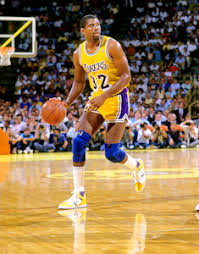
Image result for Magic Johnson Images
Magic Johnson (Basketballphoto.com)
1. Point Guard - Magic Johnson.  Magic Johnson brought a completely new dimension to the point guard position. His court vision was unmatched, as was his ability to deliver a pass to a teammate from virtually anywhere on the court. The first three-quarter court bounce pass I ever saw was one Magic threw to James Worthy that split two defenders over 30 feet away.  He could make the most difficult pass look routine. Johnson was also an underrated shooter, especially in the clutch. I was surprised to find out that his career field goal percentage was over 53%. He carried the Lakers to an upset of the top seeded Portland Trailblazers in the Western Conference Finals before losing the 1991 championship to a stronger Chicago Bulls team. So he gets a few points for consistently getting his teams in a position to win it all, even if they came up short at times.
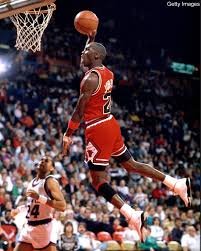
Image result for michael jordan
Michael Jordan (AllExpress.com)
2. Shooting Guard - Michael Jordan. MJ was as tough a competitor as you will ever find. Many of us knew he was capable of going off for 50 - 60 points every time he took the court. Jordan's ability to get to the rim gave defenses nightmares. And if teams tried to beat the crap out of him whenever he got into the paint (like Boston and Detroit did early on),  he killed them with a consistent mid-range jump shot. MJ was at his best in the playoffs. He is still ranked first in playoff scoring average, and he was pretty deadly in the clutch.  Jordan shot a rather pedestrian 32% from the three point line, but his teams had several sharpshooters to carry that load. Besides, he wouldn't need to shoot three pointers that much on my team because of this next guy.
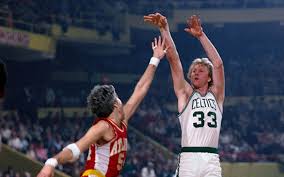
Image result for Larry Bird
Larry Bird (CBSSports.com/Getty Images)
3.) Small Forward - Larry Bird. As a Lakers fan, Bird scared the living daylights out of me. You want to talk about impact? The year before the Celtics drafted him, they lost over 60 games. During his rookie year, they won 60 games. Bird wasn't blessed with a lot of speed, but he had uncanny quickness and terrific footwork. And there weren't many players that could get their shot off faster than he could. Larry Legend was a threat from practically anywhere on the court. He was also the best passing small forward I have ever seen.  He shot nearly 40% from the three point line. That was impressive enough, but at crunch time, it seemed more like 95%.

Image result for Tim Duncan
Tim Duncan (Ronald Martinez/Getty Images)
4.) Power Forward - Tim Duncan. Sorry, but I just had to make an exception to my Hall of Fame rule here. Duncan's resume is a model of consistency. He has achieved such a high level of excellence that it can't be ignored. Since Duncan has been with the Spurs, they have won at least 50 games every year except 1999 when the season was only 50 games long.  They even won 50 during the 2012 lockout season when it was only a 66 game schedule. He also has five championships in six trips to the finals. Statistically, Duncan ranks 14th overall in total points and 8th in rebounds. And he is still not finished playing.
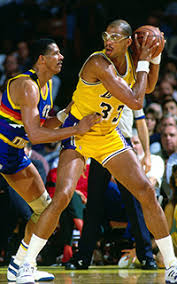
Image result for kareem abdul jabbar
Kareem Abdul-Jabbar (nba.com)
5.) Center - Kareem Abdul-Jabbar.  This one was a little tough. Wilt Chamberlain and Russell had more rebounds (Jabbar was 3rd behind them). Russell was also a better defender. However, Jabbar was ranked higher than either of the other two in assists. He's also going to be the career scoring leader for the foreseeable future. I went with Jabbar because he was more of an offensive threat than Russell, and he helped his team win more championships than Chamberlain. I am not going to deny that my fan bias played into this to some degree. If you want to throw rocks at me, give me a second to don my protective gear.

So that's my five. Just so you all know, as some of today's stars retire, I reserve the right to amend this list. How does it square with  your best five? What factors did you consider when making your choices?  Heavily weighted fan bias is more than welcome as long as a reasonable case can be made. I look forward to reading what you all think.

Until next time . . .

Karl